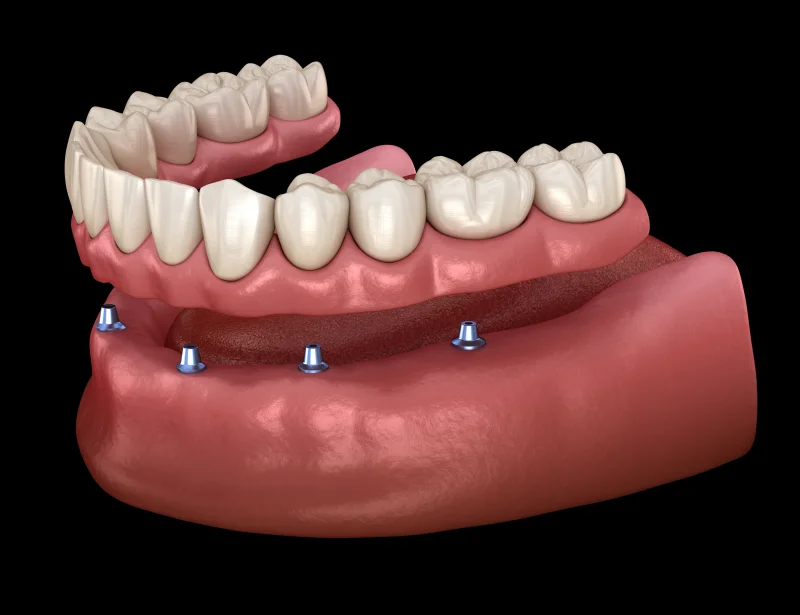
Multiple Dental Implant Treatment
Missing several teeth causes patients not only aesthetic loss but also impaired chewing function, speech (phonation) problems, alveolar bone resorption and a marked decline in quality of life. Multiple dental implant treatment is a scientifically accepted treatment approach with high success rates that aims to eliminate these problems. This article takes a literature-based approach to the biological basis, clinical indications, planning principles, and surgical and prosthetic stages of multiple dental implant treatment, as well as the consequences that may arise if missing teeth are left untreated.
1. Introduction
Tooth loss is one of the most common oral health problems in the adult population. Particularly when several teeth have been lost, conventional prosthetic solutions often fall short from both a functional and a biological perspective. The stability problems of removable dentures, the need to prepare adjacent teeth for bridges and ongoing alveolar bone loss have brought alternative treatment approaches to the fore.
In this context, multiple dental implant treatment is regarded as the rehabilitation option closest to natural teeth, both biologically and functionally.
2. What Is Multiple Dental Implant Treatment?
Multiple dental implant treatment is a treatment approach that, in cases where two or more teeth are missing, involves placing endosseous implants in place of the missing tooth roots and fitting fixed or implant-supported prosthetic restorations on these implants.
Implants are made from biocompatible materials (usually titanium or titanium alloys) and form a direct connection with the jawbone through osseointegration.
3. The Biological Basis of Osseointegration
Osseointegration is defined as direct contact between the implant surface and living bone without any intervening fibrous tissue. This biological process forms the basis for the long-term success of implant treatment.
The factors that affect the success of osseointegration in multiple implant cases are:
Bone quality and quantity
Implant surface characteristics
Minimal surgical trauma
Achieving primary stability
The patient's systemic health
Each of these factors should be evaluated individually when planning multiple implants.
4. Clinical Indications
Multiple dental implant treatment is clinically indicated in the following situations:
Partial edentulism with several missing teeth
Patients who do not have enough abutment teeth for a bridge
Individuals who cannot tolerate removable dentures
Patients with severely impaired chewing function
Cases with high aesthetic expectations
Before a treatment decision is made, the patient's general health and oral hygiene habits must be evaluated.
5. Planning Multiple Dental Implant Treatment
The foundation of successful multiple implant treatment is accurate and detailed planning. The planning process should follow a multidisciplinary approach.
5.1. Clinical and Radiological Evaluation
Three-dimensional dental tomography (CBCT) is the gold standard for evaluating bone volume and anatomical structures. Critical structures such as the sinus cavities, the mandibular canal and the mental foramen should be analyzed in detail.
5.2. Prosthetically Driven Surgical Planning
In contemporary implantology, surgery should be planned according to the prosthetic outcome. The number, position and angulation of the implants are determined by taking into account the biomechanics of the planned restoration.
6. The Surgical Phase
The main goal of the surgical phase is to achieve adequate primary stability with minimal trauma. In multiple implant cases, a longer surgical time may increase tissue trauma and the risk of complications. For this reason, atraumatic surgical techniques should be preferred.
Where necessary, advanced surgical procedures such as
Bone augmentation
Sinus lifting
Guided bone regeneration (GBR)
may be included in the plan.
7. Prosthetic Rehabilitation
In multiple implant treatment, the prosthetic phase is the most important step in determining the functional and aesthetic success of treatment.
Prosthetic options that may be used:
Implant-supported fixed bridges
Implant-supported partial dentures
Full-arch implant-supported restorations
Balanced distribution of occlusal loads among the implants is critical for long-term implant survival.
8. Advantages of Multiple Dental Implant Treatment
The scientific literature lists the main advantages of multiple implant treatment as follows:
Slowing of alveolar bone resorption
Preservation of adjacent teeth
High chewing efficiency
Fixed and stable prosthetic restoration
High patient satisfaction
These advantages have made implant treatment a preferred option for multiple missing teeth.
9. Possible Consequences If Left Untreated
When multiple missing teeth are left untreated:
Bone loss progressively increases
Temporomandibular problems may develop as the occlusal balance is disrupted
Adjacent teeth drift and tip over
Chewing and eating functions are impaired
Aesthetic and psychosocial problems arise
Over time, these conditions lead to the need for more complex and costly treatment.
10. Long-Term Success and Maintenance
The success of multiple implant treatment is not limited to the surgical and prosthetic phases. Long-term success requires:
Regular clinical check-ups
Good oral hygiene
Monitoring of the peri-implant tissues
Peri-implantitis is one of the most important complications threatening the long-term success of treatment.
11. Complications and Risk Management
As with any surgical procedure, implant treatment carries a risk of complications. However, with proper planning and experienced clinical practice, these risks can be minimized.
Possible complications:
Implant failure
Infection
Prosthetic misfit
Soft tissue problems
Detecting these complications early directly affects the success of treatment.
12. Conclusion
Multiple dental implant treatment is one of the most successful rehabilitation methods, functionally, aesthetically and biologically, for patients with several missing teeth. Correct case selection, prosthetically driven surgical planning and an interdisciplinary approach form the basis of the long-term success of treatment.
In light of current scientific evidence, multiple implant treatment is not merely a restorative solution; it is a comprehensive treatment approach that aims to restore oral function and quality of life.
DR.DT EZGİ YAZAR
Ağız ve çene cerrahisi, implant cerrahisi, gömülü diş operasyonları ve sedasyon/genel anestezi altında cerrahi diş tedavileri alanında hasta kabul etmektedir.
Have a question?
Book an appointment to get a specialist's opinion on your dental health.
Book a Free Consultation