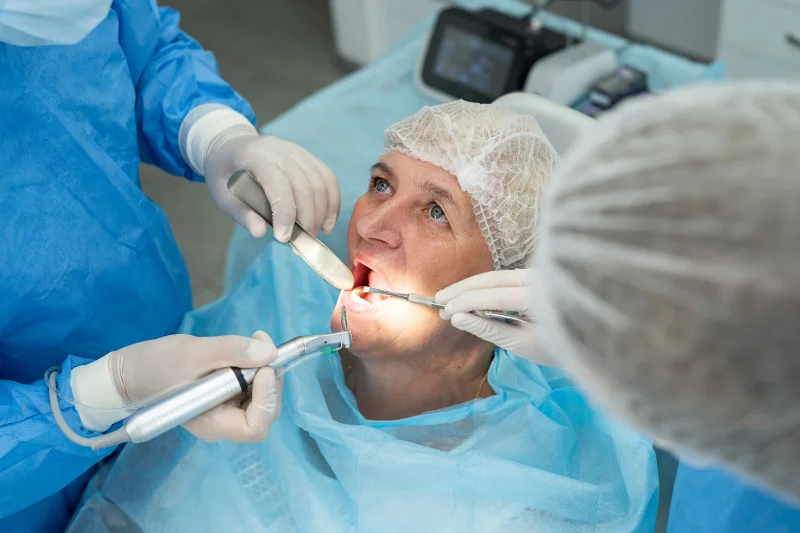

General Anesthesia in Dental Treatment: Which Patients May Need It?
Most dental treatments can be carried out under local anesthesia while the patient is awake. Many people who are afraid of the dentist can also be treated with appropriate communication, by dividing treatment into short sessions, with behavior guidance techniques or, when necessary, with the support of sedation. Nevertheless, for some children and adults it can become difficult to carry out the necessary dental procedures under standard conditions.
These situations may include intense fear of the dentist, uncontrollable movements during treatment, a strong gag reflex, certain special needs or the need for extensive dental treatment. For such patients, dental treatment under general anesthesia may be considered after the feasibility of other options has also been assessed.
The decision to use general anesthesia is not based only on questions such as “Is the patient afraid?” or “How many teeth need treatment?” The patient’s age, general health, the nature of the dental treatment, their capacity to take part in treatment, alternative methods and individual anesthesia-related risks should all be assessed together.
Particularly in pediatric dentistry, the current approach emphasizes that a range of options exists, from communication and behavior guidance techniques to sedation and general anesthesia, and that the choice of method should be made for each patient individually. The American Academy of Pediatric Dentistry also defines general anesthesia as one of the advanced behavior guidance options with specific indications.
What Is General Anesthesia?
General anesthesia is a controlled and reversible loss of consciousness induced with medication. During the procedure, the patient is not aware of what is happening around them and does not consciously respond to painful stimuli.
General anesthesia is different from normal sleep. Because the medications used can affect not only the level of consciousness but also the airway, breathing and circulation, the patient’s physiological condition is monitored throughout the procedure.
The Specialist in Anesthesiology and Reanimation assesses the patient before general anesthesia and manages the anesthesia during the procedure. Heart rhythm, blood pressure, oxygenation, breathing and other necessary parameters are monitored, and breathing and circulatory support are provided when needed.
The dentist is responsible for the dental diagnosis and treatment plan and carries out the necessary dental treatment while the patient is under anesthesia.
For this reason, dental treatment under general anesthesia is a multidisciplinary process in which dental treatment and anesthesia management are carried out together.
Does Every Patient Who Is Afraid of the Dentist Need General Anesthesia?
No.
Fear of the dentist can vary greatly in severity. Some people only feel anxious when receiving an injection, while others may struggle even to enter a dental clinic or sit in the dental chair.
For patients with mild to moderate anxiety, the causes of the fear can be identified first. Explaining the treatment in advance, short sessions, preserving the patient’s sense of control and appropriate local anesthesia may be sufficient for many patients.
Sedation may be considered for some people.
However, for some patients whose necessary treatment cannot be carried out with other methods because of severe dental phobia or panic, general anesthesia may be one of the options.
Using general anesthesia does not permanently eliminate the cause of dental fear. Because the patient may need to see a dentist again in the future for check-ups or other treatments, managing the fear is also important as part of a long-term approach.
When May General Anesthesia Be Considered for Young Children?
In children, the decision to use general anesthesia should not be based solely on the child’s age or the number of cavities.
The child’s developmental level, their ability to take part in dental treatment, the presence of pain or infection, the extent of treatment and whether it is appropriate to postpone treatment are all assessed.
Many children can gradually get used to the clinical environment and have their treatment done with communication, behavior guidance techniques and local anesthesia.
However, general anesthesia may be considered for some children who are very young and cannot have the necessary dental treatment with standard methods, who have severe anxiety, or who have urgent and extensive dental needs.
The current AAPD behavior guidance guideline states that general anesthesia may be considered for children who cannot cooperate due to a lack of psychological or developmental maturity, who experience very intense fear and anxiety or, in some cases, who require urgent and extensive dental treatment.
However, not every anxious child or every child with many cavities is a candidate for general anesthesia.
Is General Anesthesia Necessary for Patients with Special Healthcare Needs?
For patients with special healthcare needs, dental treatment should be planned individually.
Characteristics associated with the autism spectrum, Down syndrome, cerebral palsy, developmental or cognitive differences, sensory sensitivity or involuntary movements can affect dental treatment.
However, having a particular diagnosis is not, on its own, an indication for general anesthesia.
Two people with the same diagnosis may have completely different communication abilities, ability to cooperate with dental treatment and health status.
Some patients with special healthcare needs can be treated in routine clinical settings with local anesthesia. For some, shorter appointments, adjustments to the environment or communication methods suited to the individual may be sufficient. Sedation may be considered for suitable patients.
For some individuals whose necessary treatment cannot be carried out with these methods and who have other clinical needs, dental treatment under general anesthesia may be considered.
May General Anesthesia Be Needed for People with a Strong Gag Reflex?
Some people may gag noticeably when an X-ray sensor, impression tray or dental instrument is placed in the mouth.
A strong gag reflex can make procedures at the back of the mouth, taking impressions or lengthy dental treatments more difficult.
However, here too, general anesthesia is not automatically the first option.
Approaches such as carrying out treatment in short intervals, appropriate suction, the choice of dental instruments, digital impressions in some cases and managing anxiety may be considered.
In suitable patients whose anxiety markedly worsens the reflex, sedation may help.
In selected patients for whom the necessary dental procedures cannot be carried out with other methods because of gagging, nausea or vomiting, general anesthesia may also be considered.
General anesthesia does not permanently treat the cause of a strong gag reflex; it can only allow a particular dental procedure to be carried out under different anesthesia conditions.
Is General Anesthesia Essential for Patients Who Need Many Dental Treatments?
No.
Planning many fillings, extractions, implants or surgical procedures for a patient does not in itself require general anesthesia.
Many extensive dental treatments can be carried out under local anesthesia over separate sessions.
General anesthesia may be considered particularly when, in addition to the need for extensive treatment, there is difficulty cooperating with treatment, severe dental anxiety or other clinical reasons.
In suitable patients, several procedures may be planned for the same session under general anesthesia. However, it cannot be guaranteed that all treatments will be completed in a single session.
Implant treatments, prosthetic work and surgical procedures that require healing may involve separate stages.
The aim is not to carry out as many procedures as possible in one session, but to plan the necessary procedures to an appropriate extent, taking into account the patient’s dental needs and general health.
Is General Anesthesia More Suitable for Patients with Heart Disease or High Blood Pressure?
It is not correct to set a general rule on this.
For patients with uncontrolled hypertension, significant heart disease or other systemic problems, general anesthesia is not automatically a safer option. On the contrary, coexisting conditions are of particular importance in the anesthesia risk assessment.
The urgency of the dental procedure, how well the condition is controlled, the planned dental procedure and the anesthesia methods that could be used should all be assessed together.
In some cases, the patient’s current health condition may first need to be assessed by the relevant physician, or their treatment adjusted.
For this reason, generalizations such as “General anesthesia is safer because stress is harmful for heart patients” should not be made.
What Assessments Are Carried Out Before General Anesthesia?
Before anesthesia is planned, the patient’s existing medical conditions, regular medications, allergies and previous experiences with anesthesia are assessed.
If a significant problem occurred during a previous anesthetic, this must be reported.
Airway and breathing characteristics are also part of the planning.
Not every patient needs the same blood tests or examinations. The necessary assessments are determined according to the patient’s age, general health and the planned procedures.
The anesthesia team also gives the patient instructions on when to stop eating and drinking. Regular medications should not be stopped without consulting a healthcare professional.
Is General Anesthesia Completely Safe?
General anesthesia is a widely used method in modern medicine, but it is not completely risk-free.
After anesthesia, some patients may experience nausea, vomiting, throat discomfort, shivering or drowsiness. More serious complications are also medically possible.
An individual’s level of risk can be affected by age, general health, existing conditions, the nature of the procedure and other individual factors.
The Royal College of Anaesthetists states that the risks associated with general anesthesia may be higher or lower for an individual than the average statistics, and that personal risks should be assessed with an anesthesiologist.
For this reason, generalizations such as “general anesthesia is extremely safe” or “general anesthesia is very dangerous” are no substitute for an individual risk assessment.
What Happens If General Anesthesia Is Not Used?
The answer to this question also depends on the patient and the dental problem involved.
The reason general anesthesia is considered is often not the anesthesia itself but rather the fact that the necessary dental treatment cannot be carried out by other means.
Untreated advanced tooth decay can progress over time to pain, loss of tooth structure or infection. The chances of some teeth being saved may decrease.
However, this should not lead to the conclusion that “if general anesthesia is not used, a serious health problem will inevitably develop.”
Some treatments can be postponed, divided into separate sessions or carried out with alternative methods. In cases of pain, active infection or dental emergencies, the timing of treatment may be assessed differently.
The decision to use general anesthesia should be made by weighing up the possible benefits, risks and alternatives of both using and not using general anesthesia.
General Anesthesia or Sedation?
Sedation and general anesthesia are not the same method.
Under minimal or moderate sedation, the patient can usually respond to verbal instructions. Under deep sedation, responsiveness may be reduced and airway support may be needed.
Under general anesthesia, there is a controlled loss of consciousness.
Sedation should not be thought of as the “mild” version and general anesthesia as the “strong” version. Each method has its own clinical uses and risks.
For dental pain control, with either method local anesthesia may also be given separately when needed.
Which method is appropriate should be decided by assessing the patient’s medical condition and the dental treatment required.
Conclusion: Who May Need General Anesthesia for Dental Treatment?
General anesthesia in dental treatment is not a routine or first-line option for every patient.
General anesthesia may be considered for some children whose dental treatment cannot be carried out with local anesthesia, communication and behavior guidance techniques; for adults with severe dental phobia; for people who cannot undergo necessary procedures because of a strong gag reflex; and for some patients with special healthcare needs.
The need for extensive dental treatment may also be part of the decision, but the number of procedures alone does not constitute an indication for general anesthesia.
Likewise, having heart disease, hypertension or a particular medical diagnosis does not automatically mean that general anesthesia is more appropriate.
When deciding on general anesthesia, the key question should not be “Does this patient have to be put to sleep?” but rather “Taking this person’s medical and individual characteristics into account, which method can be used to carry out the necessary dental treatment?”
While the dentist plans the necessary oral and dental treatment, the Specialist in Anesthesiology and Reanimation carries out the patient’s anesthesia assessment and manages the anesthesia.
The aim is not to steer the patient toward a particular anesthesia method, but to create an appropriate treatment plan by evaluating local anesthesia, behavioral approaches, sedation and general anesthesia according to the patient’s needs.
This article has been prepared for general information purposes. Decisions about general anesthesia, sedation or dental treatment should be planned individually by the relevant healthcare professionals based on the person’s medical and dental assessment.
Dr. İHSAN GÜRSOY
38 yılı aşkın klinik tecrübesiyle ağız ve diş sağlığı, implantoloji, cerrahi diş çekimleri ve genel anestezi/sedasyon altında çoklu diş tedavileri alanında uzman hekimdir. Yüzlerce hastada korkusuz, ağrısız ve konforlu ameliyathane diş tedavisi süreçlerini bizzat yönetmiştir.
Have a question?
Book an appointment to get a specialist's opinion on your dental health.
Book a Free Consultation